
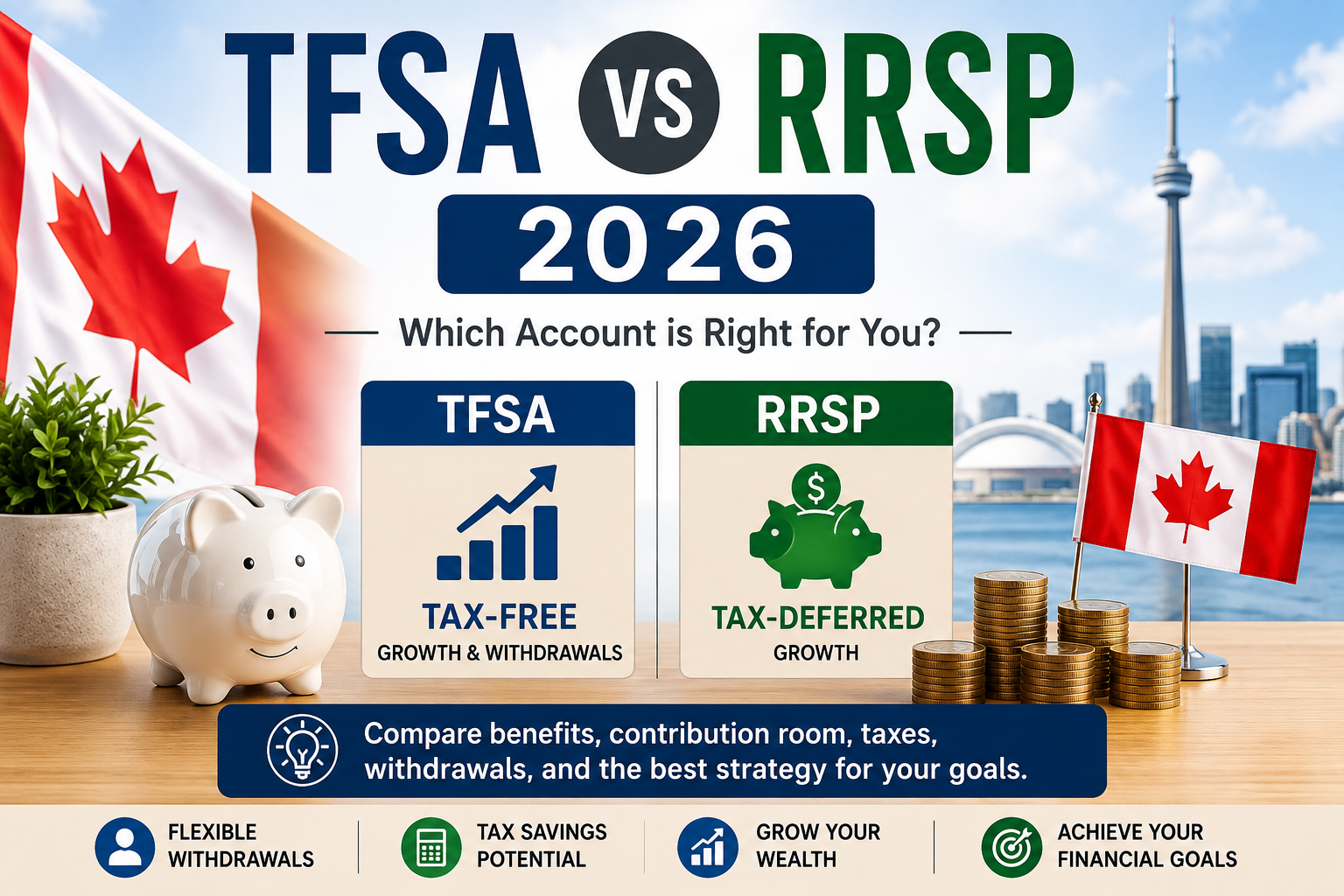
If you are trying to save or invest in Canada, you have probably heard the same two acronyms over and over again: TFSA and RRSP.
Both accounts can help your money grow in a tax-efficient way, but they work very differently.
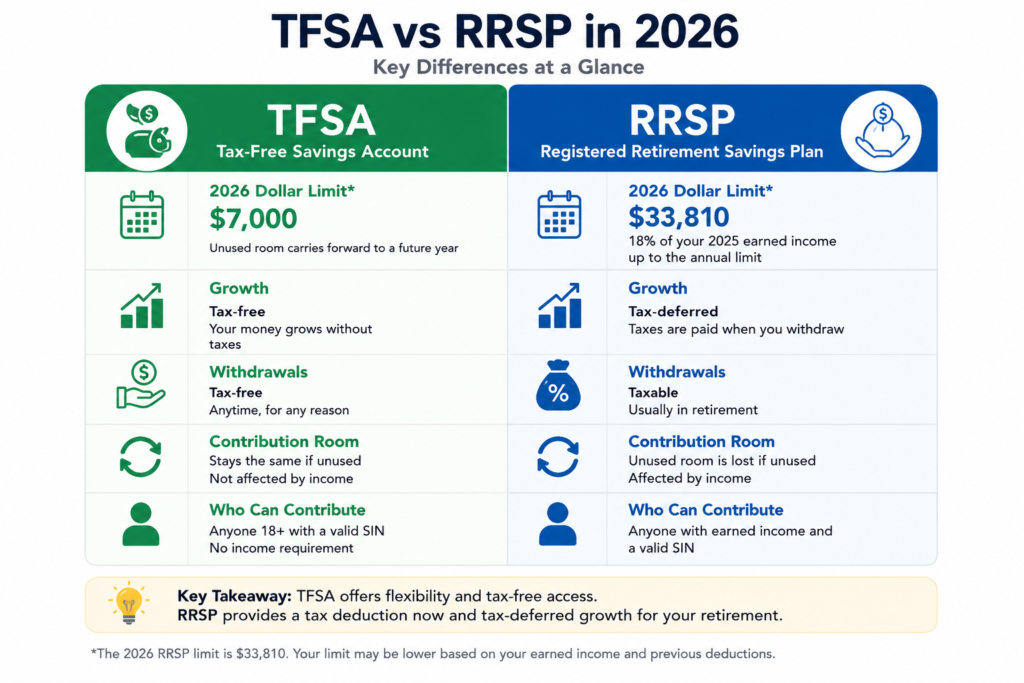
A TFSA can give you tax-free investment growth and tax-free withdrawals, while an RRSP can give you a tax deduction today but generally requires you to pay tax when you withdraw the money later.
So which one should you use first in 2026?
If you are comparing TFSA vs RRSP 2026 options, the right choice depends on your income, tax situation, savings goals, and when you expect to need the money.
Here is a straightforward comparison.
Table of Contents
TFSA vs RRSP 2026: Quick Comparison
| Feature | TFSA | RRSP |
|---|---|---|
| Full name | Tax-Free Savings Account | Registered Retirement Savings Plan |
| Contributions tax-deductible? | No | Generally yes, up to your deduction limit |
| Investment growth | Generally tax-free | Tax-deferred while money remains in the plan |
| Withdrawals | Generally tax-free | Generally taxable |
| Withdrawal added back to contribution room? | Yes, in the next calendar year | Generally no |
| 2026 annual dollar limit | $7,000 | $33,810 maximum RRSP dollar limit* |
| Unused room carries forward? | Yes | Yes |
| Main use | Flexible short- and long-term saving | Primarily retirement and long-term saving |
| Effect of withdrawals on federal income-tested benefits | Generally no effect | Withdrawals are generally taxable income |
| Age limit for contributions | No upper age limit under the regular TFSA rules | Contributions to your own RRSP generally stop after Dec. 31 of the year you turn 71 |
*The $33,810 RRSP figure is not automatically your personal contribution room. Your individual RRSP deduction limit is calculated separately.
What Is a TFSA?
A Tax-Free Savings Account (TFSA) is a registered account that allows eligible Canadians to save or invest money without paying Canadian income tax on the investment income and capital gains earned inside the account in most circumstances.
Despite the word “savings” in its name, a TFSA does not have to be just a regular savings account. Depending on the financial institution and type of TFSA you open, it may hold different eligible investments.
TFSA contributions are not tax-deductible. In other words, putting $5,000 into your TFSA does not reduce your taxable income by $5,000.
The advantage comes later: income and gains earned inside the TFSA are generally tax-free, and withdrawals are generally tax-free as well.
What Is the TFSA Limit for 2026?
The federal TFSA dollar limit for 2026 is $7,000.
But this does not necessarily mean you can contribute only $7,000 in 2026.
Unused TFSA contribution room carries forward.
For example, if you had $5,000 of unused TFSA room at the end of 2025 and you qualify for the full $7,000 of new room in 2026, you could have $12,000 available before considering any other adjustments. CRA gives the same type of example in its 2026 guidance.
Someone who was eligible for TFSA contribution room for every year since the program began in 2009 and who has never contributed could potentially have $109,000 of cumulative room by 2026. However, contribution room depends on factors including age and Canadian residency, so you should not assume that number applies to you. The CRA publishes the annual TFSA limits from 2009 onward.
The TFSA Withdrawal Rule Many People Miss
One of the most useful TFSA features is that withdrawals can eventually create contribution room again.
But there is an important catch.
If you withdraw money from your TFSA, the amount withdrawn is not added back to your available contribution room immediately. It is added back on January 1 of the following calendar year.
For example:
You have used all of your TFSA contribution room.
You withdraw $5,000 in August 2026.
That does not automatically allow you to put the same $5,000 back into the TFSA in September 2026.
Unless you already have at least $5,000 of unused contribution room, you would generally need to wait until January 1, 2027, when the withdrawn amount is added back to your room.
This matters because TFSA overcontributions can be subject to a 1% tax per month on the excess amount while the excess remains in the account.
What Is an RRSP?
A Registered Retirement Savings Plan (RRSP) is designed primarily to help Canadians save for retirement.
Its tax treatment is almost the reverse of a TFSA.
Eligible RRSP contributions can generally be deducted from taxable income, up to your available RRSP deduction limit. Investment income earned inside the RRSP is generally not taxed while it remains in the plan.
However, withdrawals from an RRSP are generally taxable.
This means an RRSP can be particularly useful when a tax deduction today is valuable and you expect to withdraw the money in a future year when your taxable income may be lower.
That is one reason RRSPs are commonly associated with retirement planning.
What Is the RRSP Limit for 2026?
This is where TFSA and RRSP limits are often misunderstood.
The 2026 RRSP dollar limit is $33,810.
But that does not mean every Canadian can contribute and deduct $33,810 in 2026.
The CRA generally calculates an individual’s RRSP deduction limit using:
- unused RRSP deduction room carried forward from the previous year
- the lesser of 18% of the previous year’s earned income and the applicable annual RRSP dollar limit
- adjustments related to pensions, including pension adjustments and certain other pension-related amounts
Because of this, two people earning different incomes—or participating in different workplace pension plans—can have very different RRSP deduction limits.
The safest way to check your own number is through your CRA account or the RRSP Deduction Limit Statement on your latest Notice of Assessment or Notice of Reassessment.
Simple Example: Why the RRSP Tax Deduction Matters
Imagine someone contributes $5,000 to an RRSP and has enough available deduction room.
That person may be able to claim the contribution as an RRSP deduction, reducing taxable income.
The exact tax savings are not automatically $5,000, and they are not the same for everyone. The value of the deduction depends on the person’s income and tax situation.
This is an important distinction.
An RRSP contribution is a tax deduction, not a dollar-for-dollar refund.
What Happens When You Withdraw From an RRSP?
Unlike a TFSA withdrawal, an ordinary RRSP withdrawal is generally included as income for the year of withdrawal.
Financial institutions also generally withhold tax when an RRSP withdrawal is made.
For Canadian residents outside Quebec, CRA’s current withholding rates for lump-sum RRSP withdrawals are:
| Withdrawal | Tax normally withheld |
| Up to $5,000 | 10% |
| More than $5,000 up to $15,000 | 20% |
| More than $15,000 | 30% |
Different rates apply in Quebec.
The withholding tax is not necessarily your final tax bill. The RRSP withdrawal is reported on your income tax return, and your final tax owing depends on your overall tax situation for that year.
Another major difference from a TFSA is that an ordinary RRSP withdrawal does not generally restore the contribution room you used.
That makes RRSP money less flexible for everyday withdrawals.
When Might a TFSA Make More Sense?
A TFSA may be particularly useful when:
You may need the money before retirement
If you are saving for something a few years away—such as a car, home renovation, emergency fund or another major expense—the TFSA’s withdrawal flexibility can be valuable.
Withdrawals are generally tax-free, and the amount withdrawn is added back to contribution room the following calendar year.
Your income is relatively low right now
If your current taxable income is relatively low, the immediate value of an RRSP tax deduction may be smaller than it would be during a higher-income year.
That doesn’t automatically make a TFSA better, but it is one factor worth considering.
You want retirement withdrawals that generally won’t affect federal income-tested benefits
TFSA income and withdrawals generally do not affect federal income-tested benefits and credits such as Old Age Security (OAS), Guaranteed Income Supplement (GIS) and Employment Insurance (EI).
That can make the TFSA particularly important as part of retirement planning for some households.
When Might an RRSP Make More Sense?
An RRSP may deserve more attention when:
You are in a higher tax bracket today
The RRSP deduction may be more valuable when your marginal tax rate is relatively high.
If you later withdraw the money when your taxable income and tax rate are lower, the difference can make the RRSP attractive.
However, future tax rates and income cannot be known with certainty, so this should not be treated as a guarantee.
You are saving specifically for retirement
RRSPs were designed as retirement savings plans, and the tax structure encourages long-term saving.
Because ordinary withdrawals are taxable and contribution room generally does not return after a withdrawal, RRSP funds tend to be less flexible than TFSA funds for short-term spending.
Your employer offers RRSP matching
If your workplace offers a matching contribution to a group RRSP or similar retirement arrangement, the employer contribution can materially change the decision.
Always review the specific rules of your employer’s plan before deciding where to direct your savings.
What If You Are Saving for Your First Home?
If buying your first home is the goal, TFSA vs RRSP is no longer the whole conversation.
Canada also has the First Home Savings Account (FHSA), which deserves its own comparison.
There is also the Home Buyers’ Plan (HBP).
Under the current HBP rules, an eligible participant can withdraw up to $60,000 from RRSPs to buy or build a qualifying home.
An eligible buyer may also be able to use an FHSA and the HBP for the same qualifying home, provided all applicable conditions are met.
Because the rules are different from ordinary RRSP withdrawals, anyone planning to buy a first home should compare the FHSA, TFSA and RRSP/HBP together, rather than looking only at TFSA vs RRSP.
Can You Have Both a TFSA and an RRSP?
Yes.
This is often overlooked because TFSA vs RRSP articles make the decision sound like an either-or choice.
They are separate registered plans, and many Canadians use both.
For example, someone might use an RRSP for long-term retirement savings and current tax deductions while maintaining a TFSA for additional retirement savings or money they may need more flexibly.
Which account should receive the next dollar depends on the person’s circumstances.
TFSA vs RRSP 2026 by Situation
Here is a simplified way to think about the decision:
| Situation | Account worth considering first |
| Need flexible access to savings | TFSA |
| Lower income today, possibly higher later | Often TFSA deserves consideration |
| High income and looking for a current tax deduction | RRSP may be attractive |
| Saving primarily for retirement | RRSP and TFSA can both make sense |
| Want withdrawals that are generally tax-free | TFSA |
| Employer offers RRSP matching | Employer RRSP deserves close attention |
| Saving for a first home | Compare FHSA, HBP/RRSP and TFSA |
| Already maxed out TFSA | RRSP may be the next registered option if room is available |
| Already maxed out RRSP | TFSA may be another registered option if room is available |
These are general examples, not personalized tax or investment recommendations.
One More Important Difference: TFSA Is Not Just a Savings Account
The name “Tax-Free Savings Account” can be misleading.
A TFSA is a type of registered account, not one specific investment.
Depending on the account and institution, a TFSA may hold eligible investments rather than simply cash.
The same basic idea applies to an RRSP: the RRSP is the registered plan or account structure, while what you hold inside it can vary.
So when comparing TFSA vs RRSP 2026 options, there are really two decisions:
- Which account should you use?
- What should you hold inside that account?
Those are not the same question.
Common TFSA and RRSP Mistakes to Avoid
1. Assuming everyone gets $33,810 of RRSP room in 2026
They don’t.
$33,810 is the 2026 RRSP dollar limit used in the calculation. Your actual RRSP deduction limit may be much lower—or you may have additional unused room carried forward. Check your CRA records.
2. Putting a TFSA withdrawal back too soon
If you withdraw money and have no unused room remaining, wait until the following calendar year before replacing it.
3. Assuming an RRSP contribution gives you an equal-sized tax refund
An RRSP contribution may reduce taxable income, but your actual tax savings depend on your personal tax situation.
4. Treating an RRSP like a regular savings account
Ordinary RRSP withdrawals are generally taxable and do not normally restore contribution room.
5. Overcontributing
TFSA excess amounts can be subject to a 1% monthly tax. RRSP excess contributions above the permitted cushion can also result in a 1% monthly tax. CRA states that RRSP contributions exceeding the deduction limit by more than $2,000 are generally subject to this tax.
Frequently Asked Questions
Is TFSA better than RRSP?
Not universally.
A TFSA offers generally tax-free withdrawals and more flexible access to money. An RRSP can provide an upfront tax deduction and tax-deferred growth but generally creates taxable income when money is withdrawn.
When comparing TFSA vs RRSP 2026 options, your income, tax rate, savings goal and timeline all matter.
What is the TFSA limit for 2026?
The TFSA annual dollar limit for 2026 is $7,000. Unused room from previous years may increase your total available contribution room.
What is the RRSP limit for 2026?
The 2026 RRSP dollar limit is $33,810, but this is not necessarily your personal RRSP deduction limit. Your actual limit depends on your income history, unused room and pension-related adjustments.
Can I withdraw money from a TFSA anytime?
Generally, yes, although the investments or financial product you hold may have its own restrictions or fees. For tax purposes, the amount withdrawn is added back to TFSA contribution room at the beginning of the following calendar year.
Do I pay tax when I withdraw from my RRSP?
Ordinary RRSP withdrawals are generally taxable income, and your financial institution will generally withhold some tax when you withdraw.
Can I use both TFSA and RRSP?
Yes. They are separate registered plans, and using one does not prevent you from having the other, provided you meet the applicable eligibility and contribution rules.
Where can I check my TFSA and RRSP contribution room?
CRA provides TFSA information through your CRA account. Because financial institution TFSA reporting may not be reflected immediately, CRA also advises taxpayers to keep their own records and verify their available room carefully.
Your RRSP deduction limit can be found through your CRA account or on the RRSP Deduction Limit Statement included with your latest Notice of Assessment or Reassessment.
Bottom Line
When comparing TFSA vs RRSP 2026, both are valuable Canadian savings tools, but their tax advantages happen at different times.
A TFSA does not give you a tax deduction when you contribute, but investment growth and withdrawals are generally tax-free.
An RRSP can give you a tax deduction when you contribute, while money grows tax-deferred inside the plan, but ordinary withdrawals are generally taxable.
For many people, the question is not ultimately “TFSA or RRSP?”
It is:
“Which one should I prioritize right now—and when should I start using the other?”
Before contributing, check your actual TFSA contribution room and RRSP deduction limit and consider your current income, expected future income, savings timeline and reason for saving.
For personalized tax or investment advice, consider speaking with a qualified tax professional or financial adviser.
Official sources: Canada Revenue Agency (CRA) guidance on Tax-Free Savings Accounts, Registered Retirement Savings Plans, contribution limits, withdrawals and the Home Buyers’ Plan.