
Table of Contents
What Are Mortgage Rates in Canada?
Mortgage rates in Canada determine how much interest you pay when you borrow money to buy a home. Even a small difference in your mortgage rate can affect your monthly payment and the total interest you pay over the life of your mortgage.
The rate you receive depends on several factors, including the mortgage term, the type of interest rate you choose, your credit history, the lender you use, and whether you qualify for a discounted rate.
Because mortgage rates change over time, it’s important to compare current offers rather than assuming the rate advertised by one lender will be the same everywhere.
Fixed vs. Variable Mortgage Rates
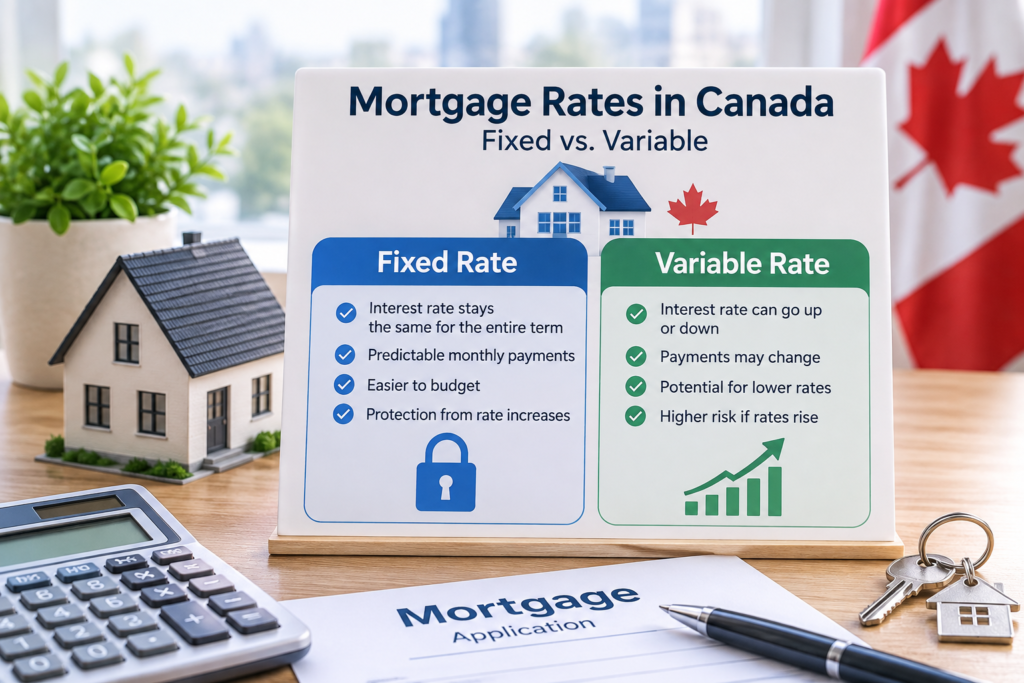
One of the biggest decisions when comparing mortgage rates in Canada is choosing between a fixed and variable rate.
Fixed Mortgage Rate
A fixed mortgage rate stays the same throughout your mortgage term. This can make budgeting easier because your interest rate does not change during the term.
A fixed rate may be a good fit if you value predictable payments or are concerned that interest rates could increase.
Variable Mortgage Rate
A variable mortgage rate can change during your mortgage term, usually in relation to the lender’s prime rate.
If rates fall, more of your payment may go toward the principal. If rates rise, more of your payment may go toward interest. Depending on the mortgage structure, your payment itself may also change.
Before choosing a variable rate, consider whether your budget could handle higher payments if rates increase.
What Affects Mortgage Rates in Canada?
Your mortgage rate isn’t determined by one factor. Lenders consider several things when setting the rate they offer you.
These can include:
- Mortgage term
- Fixed or variable rate
- Credit history
- Down payment and whether mortgage insurance is required
- Whether you qualify for a discounted rate
- Your employment or self-employment situation
- The lender you choose
Canada’s Financial Consumer Agency also recommends shopping around because the rate offered by one lender may be different from another.
Prime Rate, Posted Rate and Discounted Rate
These terms can be confusing when you start comparing mortgage rates in Canada.
Prime rate is a benchmark rate lenders use when setting interest rates for certain loan products. Each financial institution sets its own prime rate, and it is influenced by the Bank of Canada’s overnight rate.
Bank of Canada posted interest rates
Posted rate is the rate a lender advertises for a mortgage product. The rate you actually receive may be lower.
Discounted rate is a rate below the lender’s posted rate. Canada.ca recommends asking your lender whether a discounted rate is available, as the difference can save you money.
Mortgage Rate Snapshot
Bank of Canada data provides weekly posted rates from Canada’s six major chartered banks. For the week of July 22, 2026, the typical posted rates were:
| Mortgage / Rate | Typical Posted Rate |
|---|---|
| Prime rate | 4.45% |
| 1-year conventional mortgage | 5.49% |
| 3-year conventional mortgage | 6.05% |
| 5-year conventional mortgage | 6.09% |
These are posted rates, not necessarily the rate an individual borrower will receive. Your actual offer can be different depending on your lender and circumstances.
Important: Mortgage rates change, so this table should be updated when you refresh the article.
How Mortgage Rates Affect Your Payments
A higher mortgage rate generally means higher interest costs and potentially higher mortgage payments.
For example, two borrowers with the same mortgage amount and amortization period can have different monthly payments simply because they received different interest rates.
That’s why comparing mortgage rates can be just as important as comparing other mortgage features.
However, don’t choose a mortgage based on the rate alone. A mortgage with a slightly lower rate may have higher fees, stricter prepayment rules, or a larger penalty for breaking the contract.
How to Compare Mortgage Rates
When comparing mortgage rates in Canada, look beyond the headline number.
Consider:
- Interest rate — Compare the actual rate being offered.
- Mortgage term — Check how long the rate is guaranteed.
- Fixed or variable — Understand how your rate and payments can change.
- Prepayment privileges — Check how much extra you can pay without a penalty.
- Penalties — Understand what happens if you refinance or break the mortgage early.
- Fees and conditions — A lower rate isn’t always the cheapest overall option.
Canada.ca recommends shopping around before committing to a lender because comparing offers can potentially save you thousands of dollars.
Mortgage Rates and Your Pre-Approval
Mortgage rates are also important when you’re getting pre-approved for a home loan.
A pre-approval can help you understand how much you may be able to borrow and what rate a lender may offer. However, a pre-approval doesn’t necessarily mean you’ll keep that exact rate until you purchase your home.
For more information, see our guide to Mortgage Pre-Approval in Canada.
Your down payment can also affect your mortgage options and whether mortgage loan insurance is required.
Read our guide to Down Payment in Canada for more information.
Frequently Asked Questions
Are mortgage rates the same at every bank?
No. Each lender sets its own rates and may offer different rates depending on the borrower and mortgage product.
Is a fixed or variable mortgage rate better?
Neither is automatically better for everyone. A fixed rate provides more payment stability, while a variable rate can change as market rates change. Your budget and comfort with changing payments should be part of the decision.
Can I negotiate my mortgage rate?
You may be able to negotiate a lower rate with your lender. It’s also worth comparing offers from multiple lenders before making a decision.
Where can I check Canadian mortgage rates?
The Bank of Canada publishes weekly posted rates from Canada’s major chartered banks. You can also check individual lenders for their current offers.