
A mortgage renewal in Canada happens when your current mortgage term ends but you still have a balance remaining. At that point, you generally need to renew your mortgage for another term or pay the remaining balance in full.
Renewal is an important opportunity to review your interest rate, payment schedule, mortgage features and lender instead of automatically accepting the first offer you receive.
This is particularly relevant in 2026. CMHC says renewal volumes are expected to ease during the year, but many borrowers renewing mortgages that originated when rates were lower are still likely to face higher interest costs.
Table of Contents
Mortgage Renewal in Canada at a Glance
| Question | What to Know |
|---|---|
| When does renewal happen? | At the end of your mortgage term if a balance remains |
| Must you stay with the same lender? | No |
| When should you start comparing? | A few months before the term ends |
| Can you negotiate the offered rate? | Yes |
| Can switching lenders involve costs? | Yes |
| Is a stress test always required when switching? | Not for certain qualifying uninsured straight switches between federally regulated lenders |
When Will Your Lender Contact You?
If your mortgage is with a federally regulated financial institution, such as a bank, your lender must provide a renewal statement at least 21 days before the end of your existing term.
The statement must include information such as your remaining principal, interest rate, payment frequency, new term and applicable charges or fees.
The lender must also give you at least 21 days’ notice if it doesn’t intend to renew your mortgage.
You don’t have to wait for that notice to begin researching your options.
When Should You Start Shopping for a Mortgage Renewal?
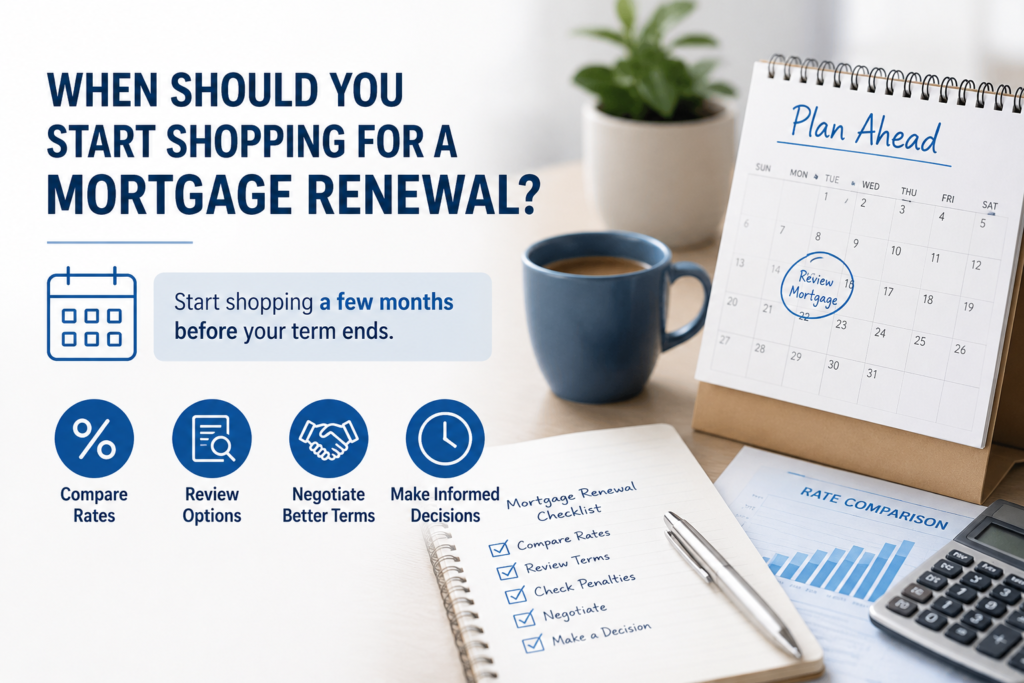
When planning a mortgage renewal in Canada, FCAC recommends shopping around a few months before the end of your term rather than waiting for your renewal letter.
Starting early gives you time to compare:
- interest rates
- fixed versus variable options
- term lengths
- payment frequency
- prepayment privileges
- fees
- lender features and service
You can also use competing offers when negotiating with your existing lender.
Should You Accept Your Lender’s Renewal Offer?
Not automatically.
Your existing lender may send you a renewal offer, but FCAC specifically recommends negotiating. You may qualify for a discounted rate below the one quoted in the renewal letter.
If you’ve received better offers elsewhere, you can mention them to your current lender. You may be asked to provide proof.
Also check whether your mortgage could renew automatically if you take no action. An automatic renewal may not provide the most competitive rate or conditions available to you.
Can You Switch Mortgage Lenders at Renewal?
Yes. With a mortgage renewal in Canada, you aren’t required to stay with your existing lender.
A new lender will need to approve your application and may use different qualification criteria. There may also be costs associated with switching, including registration, transfer or assignment fees, appraisal fees and other administrative costs.
Before switching, compare the total cost, not simply the advertised interest rate.
Ask the new lender whether it will cover any of the switching costs.
Do You Need to Pass the Mortgage Stress Test Again?
This is an important area where the rules have changed.
For most newly underwritten uninsured mortgages at federally regulated lenders, OSFI’s current minimum qualifying rate is the greater of the contract rate plus 2% or 5.25%.
However, OSFI does not expect federally regulated lenders to apply that prescribed minimum qualifying rate to an uninsured straight switch at renewal when the borrower moves the mortgage from one federally regulated lender to another without increasing either:
- the remaining amortization period, or
- the loan amount.
That doesn’t mean approval is automatic. The new lender still assesses the application under its underwriting policies.
Fixed or Variable at Renewal?
Renewal is also an opportunity to reconsider whether a fixed or variable rate suits your finances.
A fixed-rate mortgage generally provides more predictable payments during the term, while a variable rate changes according to the terms of the mortgage and movements in the lender’s applicable rate.
There isn’t one option that is best for everyone. Consider your budget, tolerance for payment or rate changes and how long you expect to keep the mortgage.
Every time you renew, you renegotiate your mortgage interest rate, so your future payments may increase or decrease.
Renewal vs Refinancing
These aren’t necessarily the same thing.
A straightforward renewal generally involves arranging a new term for the remaining mortgage balance.
Refinancing may involve making more substantial changes, such as increasing the mortgage amount to access equity or changing the amortization.
This distinction matters because changing the loan amount or amortization can affect qualification requirements and may create additional costs.
What to Review Before Renewing
Before signing a mortgage renewal in Canada, review whether your financial situation has changed since your previous term.
Consider whether you want to:
- increase payments and repay the mortgage faster
- change payment frequency
- make lump-sum payments
- change lenders
- change the mortgage term
- reconsider fixed versus variable
- review optional mortgage-related insurance
Extending amortization to reduce payments may provide short-term payment relief, but FCAC warns that doing so increases the total interest you pay. If you’re comparing your options, see our Mortgage Rates in Canada and Mortgage Pre-Approval in Canada guides for more information.
Frequently Asked Questions
Do I have to renew my mortgage with the same bank?
No. You can shop around and apply to switch to another lender at renewal.
How early should I shop for mortgage renewal?
FCAC recommends beginning a few months before your mortgage term ends.
Can I negotiate my mortgage renewal rate?
Yes. FCAC recommends negotiating with your current lender and comparing offers from other lenders or mortgage brokers.
Will I have to pass the stress test if I switch lenders?
Not necessarily. OSFI does not expect the prescribed MQR to apply to qualifying uninsured straight switches between federally regulated institutions when neither the loan amount nor remaining amortization increases. The new lender still needs to approve the mortgage.
Does switching mortgage lenders cost money?
It can. Possible costs include appraisal, registration, transfer, assignment and administrative fees. Ask whether the new lender will cover some or all of these costs.