
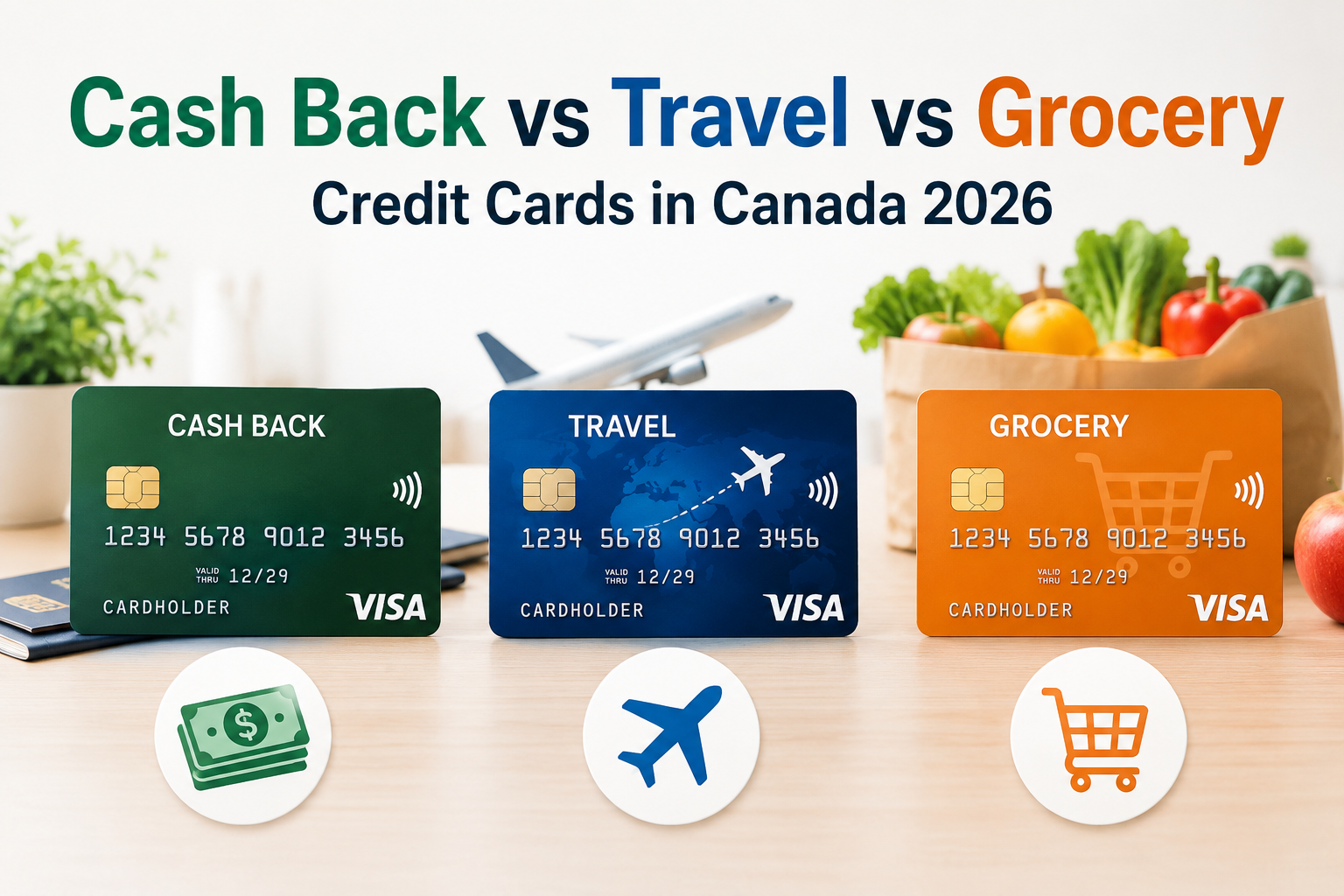
Choosing between credit cards in Canada can be confusing because rewards programs work in very different ways. Some cards return a percentage of your spending as cash back, while others offer travel points or higher rewards on everyday categories such as groceries.
The right choice depends less on which card offers the biggest advertised reward and more on where you actually spend your money, how you redeem rewards and what fees you pay.
The Financial Consumer Agency of Canada (FCAC) recommends comparing interest rates, fees, rewards and benefits before choosing a credit card. It also suggests estimating the value of rewards you expect to earn and subtracting the annual fee.
Table of Contents
Cash Back vs Travel vs Grocery Credit Cards at a Glance
| Type | May Suit You If | Main Advantage | What to Watch |
|---|---|---|---|
| Cash Back | You want simple rewards | Easy-to-understand value | Annual fees and category limits |
| Travel | You travel regularly | Travel rewards and possible benefits | Redemption rules and restrictions |
| Grocery Rewards | Groceries are a major expense | Higher rewards on eligible grocery spending | Which stores qualify and reward caps |
Cash Back Credit Cards
Cash back cards typically return a percentage of eligible purchases as cash rewards.
Their biggest advantage is simplicity. Instead of determining how much a point or mile is worth for a particular redemption, you generally know the cash value of your reward.
Some cards offer a flat cash-back rate, while others provide higher rates in selected spending categories.
However, a higher advertised cash-back percentage doesn’t automatically make a card more valuable. Annual fees and spending limits can reduce the net benefit.
FCAC gives an example in which a card earns 1% cash back but charges an $85 annual fee. With $4,800 in annual spending, the $48 reward would not cover the annual fee.
Travel Rewards Credit Cards
Travel credit cards generally allow you to earn points or miles that can be redeemed toward travel-related purchases.
Depending on the program, rewards may be used for flights, hotels or other travel expenses. Some cards may also include additional travel benefits.
Travel rewards can be attractive to people who travel frequently and can make good use of the program’s benefits.
But they can also be more complicated than cash back.
Redemption values and restrictions may vary, and some travel loyalty programs may have limitations such as blackout periods or limited reward availability.
Before choosing a travel card, consider whether you’ll realistically use enough of its rewards and benefits to justify any annual fee.
Grocery Rewards Credit Cards
A grocery rewards card isn’t necessarily a completely separate class of credit card. It usually refers to a rewards or cash-back card that provides enhanced rewards for eligible grocery purchases.
This type of card may be useful for households that spend a significant amount on groceries each month.
But the headline earning rate isn’t the only thing that matters.
Check:
- which merchants qualify as grocery stores
- whether there’s a spending cap
- what happens after reaching the cap
- how rewards are redeemed
- whether the card charges an annual fee
FCAC illustrates grocery rewards with an example in which annual grocery spending is compared against points earned and the card’s annual fee to determine the actual benefit.
Which Type of Credit Card Is Better?

When comparing credit cards in Canada, there isn’t one option that is right for everyone.
Cash back may make more sense if you prefer straightforward rewards and don’t want to manage a complicated points program.
Travel rewards may make more sense if you travel regularly and can use the available redemption options and benefits.
Grocery-focused rewards may make more sense if groceries represent a large portion of your household spending and your usual stores qualify for the card’s enhanced earning rate.
The important number is the net value you receive after fees, not simply the advertised reward rate.
Don’t Ignore Interest Rates
Rewards shouldn’t be the first priority if you regularly carry a credit card balance.
FCAC notes that a higher interest rate increases the cost of an outstanding balance and that interest costs may reduce the value of rewards and benefits.
For example, earning a few percent in rewards may provide little benefit if you’re simultaneously paying substantial interest on unpaid purchases.
If you regularly carry a balance, comparing lower-interest cards may therefore be more important than maximizing rewards.
What About Annual Fees?
Some credit cards in Canada charge an annual fee in exchange for additional rewards or benefits, while others have no annual fee.
A card with an annual fee isn’t automatically better or worse.
A simple way to compare is:
Estimated annual rewards + benefits you will actually use − annual fee
FCAC specifically recommends considering whether rewards and benefits are worth the annual fee and whether a similar no-fee option is available.
If avoiding annual fees is your priority, see our No Annual Fee Credit Cards in Canada 2026 guide.
How to Compare Credit Cards in Canada
Before applying, compare cards based on your own spending rather than advertisements.
Look at your typical monthly spending on groceries, transportation, dining, travel and other purchases. Estimate how much you would earn under each rewards structure and subtract the annual fee.
Also check interest rates, redemption restrictions and other fees.
FCAC provides a Credit Card Comparison Tool that allows consumers to compare interest rates, annual fees, rewards and other features across Canadian cards.
Frequently Asked Questions
Is cash back better than travel rewards?
Not necessarily. When comparing credit cards in Canada, cash back provides straightforward value, while travel rewards may be more useful for someone who travels frequently.
Are grocery credit cards worth it?
They may be worthwhile if groceries account for a large part of your spending, but you should check eligible merchants, earning limits, redemption rules and annual fees.
Should I pay an annual fee for a rewards credit card?
It depends on whether the rewards and benefits you actually use exceed the annual fee. FCAC recommends estimating the annual value before choosing a rewards card.
Do rewards matter if I carry a credit card balance?
Interest costs can outweigh the value of rewards. If you regularly carry a balance, the card’s interest rate may be more important than its rewards program.
How can I compare credit cards in Canada?
You can compare interest rates, annual fees, rewards and other features using the Government of Canada’s Credit Card Comparison Tool.